The Hidden Cost of Manual Lifting
Every day in American warehouses and shops, workers bend, lift, and carry heavy objects. The motion seems simple. But repeat it fifty times, and the toll on the lower back becomes real. According to workplace injury data, manual material handling causes a significant portion of reported back injuries. The cost shows up not just in medical claims but in lost productivity and worker turnover.
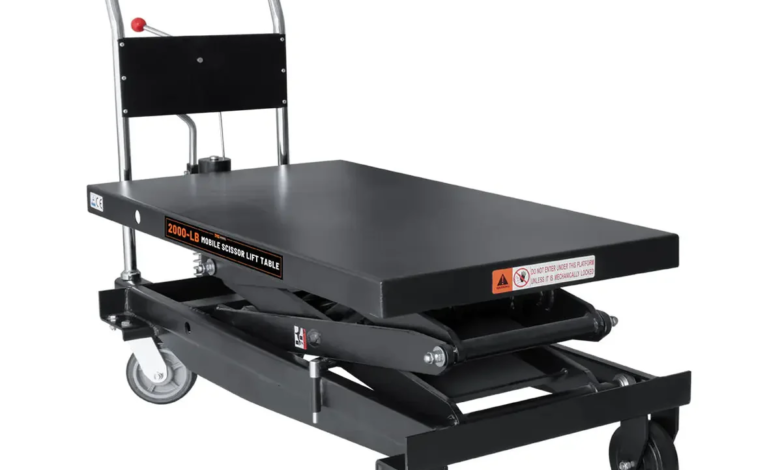
A mobile scissor lift table addresses this problem directly. It brings the load to the worker instead of forcing the worker to stoop to the load. This simple inversion of the lifting process eliminates the most hazardous part of the job.
How the Lift Table Works
The device uses a scissor mechanism hidden beneath a steel platform. A foot pedal operates a hydraulic pump. Each pump stroke raises the platform a small increment. The operator pumps until the load reaches a comfortable working height. A release valve on the handle lowers the platform at a controlled speed.
The numbers tell the story. The platform starts at 20 inches from the floor. At its highest, it reaches 67 inches. This range covers almost every work surface height encountered in a typical shop. The 2200-pound capacity handles heavy machinery parts, fully loaded tool chests, and palletized freight. The platform measures 47 inches by 24 inches, large enough for standard pallets but compact enough to maneuver in tight aisles.
Key specifications include:
- 2200-pound load capacity
- 20-inch minimum height
- 67-inch maximum height
- 47 by 24-inch platform
- Four casters with locking brakes
Transforming Daily Workflows
Consider a typical machine shop. An operator feeds steel bars into a cutoff saw. Each bar weighs 80 pounds. The saw table sits at 40 inches. Without a lift table, the operator picks each bar from a floor-level pallet and lifts it to the saw table. Two hundred bars per shift means 200 lifts. The math is brutal.
With a lift table, the pallet sits on the platform. The operator raises the platform to match the saw table height. Now the bars slide directly from pallet to saw. No lifting. No bending. The operator preserves energy for work that adds value.
Common applications include:
- Feeding materials into saws, presses, and assembly stations
- Positioning heavy components for repair
- Unloading delivery pallets
- Transporting tooling between work cells
- Lifting engines and transmissions for service
Safety and Operational Discipline
Simple design does not mean casual operation. The 2200-pound capacity demands respect. Loads must be centered on the platform. Off-center loads can tip the table or bind the scissor mechanism. Casters must be locked before raising the platform. An unlocked table can roll during lifting, creating instability.
The hydraulic system requires regular attention. Check fluid levels periodically. Open the descent valve slowly; sudden release causes the platform to drop too quickly. Clean the casters of debris that can cause flat spots or binding.
Safe operation requires these practices:
- Never exceed 2200 pounds
- Center every load
- Lock casters before raising
- Keep hands clear of the scissor mechanism
- Lower the platform fully before moving
Real-World Impact
An Ohio machine shop fed 80-pound steel bars into a cutoff saw. The operator lifted each bar from floor level to the 40-inch saw table. Two hundred bars per shift. The shop introduced a scissor lift table. The operator now slides bars from the pallet to the saw. Shoulder and back injuries among saw operators dropped to zero. Production increased because operator fatigue no longer slowed the afternoon shift.
The Future of Material Handling
Scissor lift tables are mature technology, but improvements continue. Battery-powered hydraulic pumps eliminate foot pedal pumping, reducing operator effort further. Integrated scales allow weighing loads during transport. Wireless controls let operators raise and lower the table from a distance. These refinements will not change the fundamental value: bringing the load to the worker, not the worker to the load.
For any shop where workers lift heavy items from the floor, the scissor lift table is not an accessory. It is a basic tool of workplace safety and productivity.