Driving a powerboat for the first time is a bit like driving a car for the first time — except the road moves, there are no lane markings, and if you stall you don’t quietly roll to a stop on the kerb. It’s more demanding than it looks from the shore, which is exactly what makes it worth doing properly.
Britain has a serious relationship with the water. We’re an island nation with over 11,000 miles of coastline, and powerboating has been part of that culture for well over a century — the first motorboat race on the Thames was held in 1903. Today, the RYA (Royal Yachting Association) runs one of the most respected powerboat training schemes in the world, with accredited centres from the Solent up to the Scottish lochs. Whether you’re after a one-off powerboat adventure or a qualification you can actually use, the options are better than most people realise.
The Difference Between an Experience and a Course
These are two distinct things, and it’s worth knowing which one you actually want before you book.
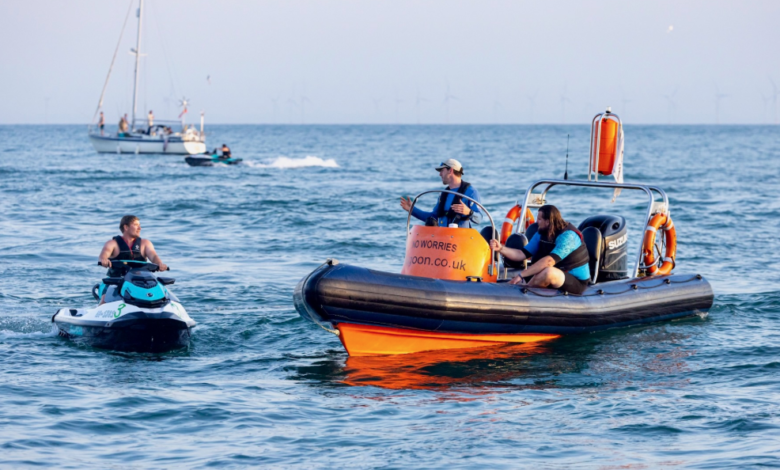
A powerboat adventure — typically a guided RIB blast with a qualified skipper — needs no experience and no licence. You turn up, get briefed, and spend an hour or two on the water at speed. These run all over the country and are a legitimate way to experience what a fast boat actually feels like without committing to training. Poole Harbour, which is the second largest natural harbour in the world, is one of the best places for this. Operators run trips from here past Old Harry Rocks along the Jurassic Coast — 65-million-year-old chalk stacks sitting just off Studland Bay — and the combination of speed and scenery is hard to beat. In Scotland, similar RIB adventures run on Loch Ness and around the Anglesey coastline in Wales.
A power boat course is a different proposition. The RYA Powerboat Level 2 is the benchmark qualification — it’s essentially what the scheme is built around, and most adults go straight to it without bothering with Level 1. The course runs over two days, with a maximum of three students per instructor, and covers close-quarters boat handling, man overboard recovery, anchoring, passage planning using charts and tides, and driving at planing speed. No prior experience is needed. Costs start from around £199 and go up to around £349 depending on location and time of year.
What you get at the end is more useful than people expect. The Level 2 certificate lets you apply for an ICC — the International Certificate of Competence — which is a legal requirement for helming a powerboat up to 10 metres in many countries outside the UK. So if you’ve ever thought about hiring a boat on holiday in Greece, Croatia, or the Mediterranean more generally, the Level 2 is the qualification that makes that possible.
See also: What Homeowners Should Know about Siding Repair and Installation Procedures in Dallas
Where to Take a Power Boat Course
The Solent is the most popular area for training, and for good reason. Southampton Water gives you access to tidal coastal water, busy shipping lanes, and varied conditions that make the learning genuine rather than theoretical. Several large RYA training centres operate here, with fleets of RIBs ranging from 6 to 7.5 metres.
Poole Harbour in Dorset is another strong option. Training here puts you on the water with direct access to the Bristol Channel and Jurassic Coastline, which means the navigation elements of the course have real context rather than being purely academic.
For those based further north, Bristol Maritime Academy runs Level 2 courses out of Portishead Marina, locking out onto the Bristol Channel for the coastal sections — a slightly more unusual environment that gives students experience of flowing tidal water from the start.
What Comes After Level 2
Most people stop at Level 2 and that’s fine for recreational use. But the RYA scheme continues — the Intermediate course builds on passage planning for longer coastal trips, and the Advanced qualification is the level needed for commercial skippering. There’s also a Safety Boat course, which is worth knowing about if you’re involved in any kind of watersports club or event.
You can browse power boat adventures and power boat courses across the UK on Adventuro, filtered by location and experience level.