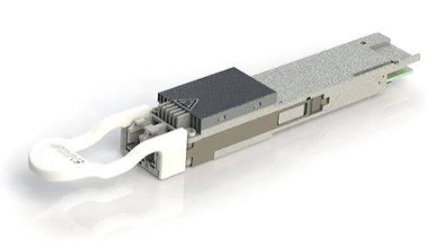
For two decades, coherent optical transmission belonged to a dedicated box. Line cards, transponders, and purpose-built terminals handled the heavy signal processing, while routers and switches stayed in their lane. The arrival of 800G ZR and ZR+ coherent pluggables breaks that separation. A module the size of a thick paperback now carries a single 800G wavelength directly from a router or switch port into an amplified DWDM line system, and the operational consequences reach well beyond the form factor itself. Understanding what these modules actually do—and what they do not do—is the difference between a clean DCI architecture and a rack of expensive optics that cannot establish a link.
Two Modules, Two Jobs: 800ZR and 800G ZR+ Are Not Interchangeable
The names look like a family of similar products, but 800ZR and 800G ZR+ answer different network problems. 800ZR is defined by the Optical Internetworking Forum Implementation Agreement and is engineered for single-span, point-to-point data center interconnect. In its amplified form it reaches roughly 120 km, and unamplified it covers about 75 km—enough to connect two metro data centers on a dedicated fiber pair without touching a multi-span line system. Its modulation is fixed at DP-16QAM, its line rate is fixed at 800G, and its power draw lands in the 24–25 W range. That fixed behavior is a feature, not a limitation: it makes 800ZR predictable to deploy and straightforward to validate in a link budget.
800G ZR+ takes the same pluggable concept and stretches it into regional and long-haul territory. It adds probabilistic constellation shaping, which lets the module trade spectral efficiency for noise tolerance, and it supports flexible line rates from 100G to 800G depending on link conditions. At 800G, an 800G ZR+ OSFP module can reach beyond 1000 km with external amplification; at 400G that same module can cover distances approaching 3000 km, and it can traverse a limited number of ROADM nodes without forcing a dedicated regeneration site. Power consumption climbs accordingly, typically into the 26–32 W range. Calling one “better” than the other misses the point. 800ZR is the right tool for a clean, single-span DCI pipe; 800G ZR+ is the right tool when the fiber route is longer, the line system is older, or the operator needs to carry 800G across multiple spans without building a transponder layer.
See also: Lifeguard Course: Essential Training for Water Safety and Emergencies
The Real Shift: IPoDWDM Moves Coherent Transport into the Router
The deeper change is architectural. In a traditional DWDM deployment, a router port connects over a short grey optic to a transponder, and the transponder performs the coherent line-side work. That transponder occupies rack space, consumes its own power and cooling, and adds a management domain between the router and the optical line. With an 800G ZR or ZR+ pluggable, the coherent DSP sits inside the router or switch port. The router now owns the line-side wavelength directly, a model commonly called IPoDWDM.
The economics of that shift are difficult to ignore. Coherent pluggables reduce footprint and power consumption relative to transponder-based systems by wide margins—industry analyses have cited figures on the order of a 36% reduction in watts per gigabit and up to a 50% reduction in rack units, alongside meaningful per-gigabit capex savings. Those savings are not theoretical bookkeeping. In a large DCI build, every rack unit and every watt of cooling removed from the optical layer compounds across hundreds of links. The pluggable model also simplifies operations: the same router operating system that manages the IP port now manages the coherent wavelength, which reduces the number of management silos and handoffs in a link turn-up.
This is also where the optical form factor choices start to matter. 800G coherent modules appear in both QSFP-DD and OSFP packages, and the OSFP variant has become a common vehicle for 800G ZR+ because its thermal headroom suits the higher-power, higher-performance modes. The choice is not cosmetic. Port-density, faceplate airflow, and host ASIC compatibility all flow from which cage the platform exposes, and mixing packages across a fleet adds sparing and training overhead that rarely shows up in a datasheet comparison.
Where Coherent Pluggables Fit Alongside the Existing Fiber Plant
A common misreading of the 800G coherent story is that it makes every other optical module obsolete. In practice, coherent pluggables solve the long-reach, high-capacity problem, while a separate class of optics continues to handle short-reach and fiber-constrained links inside and between nearby buildings. The two layers coexist, and the boundary between them is set by fiber availability more than by headline speed.
Consider the short-reach side. A QSFP-40/100-SRBD module is a dual-rate bidirectional transceiver that runs 40G or 100G over multimode fiber using a duplex LC connector, with reach up to 100 meters on OM4. Its appeal is not raw capacity but simplicity: it lets an operator move a 40G link to 100G without replacing the multimode cabling or the LC patch panels. The 100G BiDi QSFP28 family pushes the same single-fiber philosophy further, using bidirectional transmission to double the usable capacity of a fiber strand and offering reach options that extend from a few kilometers to tens of kilometers depending on the variant. These modules occupy a different design space from 800G ZR/ZR+, but they show why coherent pluggables do not simply flatten the optics hierarchy. A DCI link that needs 800G over 120 km and a campus link that needs 100G over a single strand of installed fiber are both legitimate problems, and each has a purpose-built answer.
The practical planning question is not whether to standardize on coherent everywhere, but where the coherent boundary belongs. If a route is short, unamplified, and single-span, an 800ZR pluggable is the cleanest option. If the route crosses multiple spans, hits ROADM filtering, or must survive an older fiber with higher loss, 800G ZR+ buys the margin needed to avoid a transponder—at the cost of more power and a more careful link budget. And if the limitation is not reach but fiber count, a bidirectional short-reach module may solve the immediate problem at a fraction of the coherent cost. Treating these as layers in one architecture, rather than competing replacements, is how the economics stay favorable.
What to Validate Before Committing to 800G Coherent Ports
The most expensive mistake with 800G coherent pluggables is assuming that a port that accepts the module will make the link work. Host compatibility is a stack, not a checkbox. The platform must expose the right cage type and thermals for the chosen package, the installed network operating system must recognize the module and support the required line mode, and the optical line system must present a usable channel plan and power budget for the specific ZR or ZR+ profile being deployed.
Start with the host. An 800G OSFP ZR+ module needs an OSFP cage and a host port rated for the module’s power envelope; a platform designed around lower-power 400G optics may not provide enough faceplate airflow even if the cage physically accepts the module. Confirm the port’s supported Ethernet and line-side modes in the NOS release notes, not just in the hardware datasheet, because coherent mode support often arrives with software revisions.
Then validate the line side against the module’s actual profile. 800ZR and 800G ZR+ are not interchangeable line interfaces, and “ZR+” on a product label does not guarantee compliance with any single multi-source agreement. Some ZR+ implementations are vendor-specific extensions, while OpenZR+ is a separate MSA effort aimed at multi-vendor interoperability. Ask for the compliance statement and the application codes the module actually supports. A link budget built on nominal reach figures will underestimate the penalty from ROADM filtering, connector aging, and fiber nonlinearities; the only safe approach is to calculate OSNR and dispersion against the real span, then confirm that the module’s FEC and shaping modes can close the link with margin.
Finally, separate the two upgrade paths that often get conflated. One path is introducing 800G coherent ports into a new router or switch platform and lighting 800G wavelengths on existing fiber. The other is trying to push 800G coherent capacity through a line system designed for 100G or 400G channel spacing. The pluggable solves the first problem; the second is a line-system engineering problem that no module can solve alone. Getting that distinction right before purchase is worth more than any single datasheet number.
The 800G ZR and ZR+ generation does not make coherent transport simple. It makes it portable. The DSP, the optics, and the tuning logic now live in a hot-pluggable package, and that changes who owns the wavelength and how quickly a DCI link can be turned up. But portability also moves the burden of validation onto the host and the line system. The teams that plan for that shift—matching module profile to route, confirming host support before ordering, and budgeting optical margin rather than trusting nominal reach—will capture the space and power savings that made pluggable coherent optics worth pursuing in the first place.