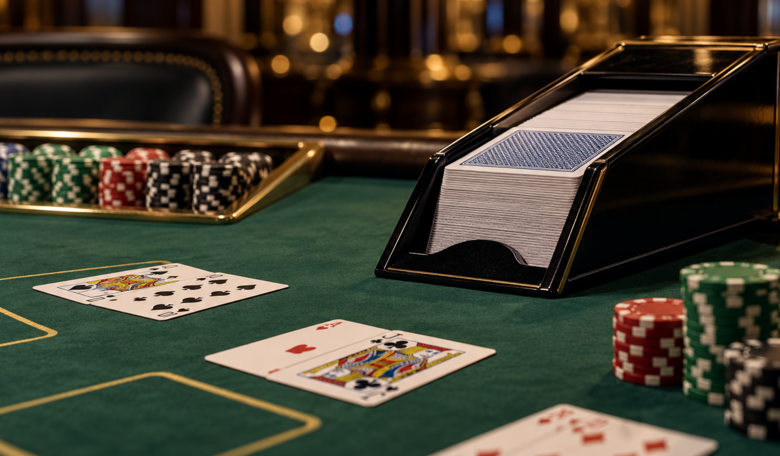
A blackjack shoe looks simple: a container holding several shuffled decks. Yet its arithmetic is more revealing than the hardware. A six-deck shoe begins with 312 cards, but that number is only the starting inventory. The cut card determines how much is actually used, while card consumption changes from round to round. That is why “six decks” does not translate into a fixed number of rounds.
Live blackjack tables are streamed to players in Canada, including through ToonieBet’s live blackjack canada lobby for users outside Ontario. The digital interface does not change the underlying arithmetic of a conventional six-deck shoe: six standard 52-card decks still produce 312 cards before play begins.
Six decks means 312 cards before the first deal
The first calculation is straightforward: 6 × 52 = 312. Inside that pool are 24 aces and 24 cards of every individual rank. Grouped by blackjack value, the shoe contains 192 cards ranked 2 through 9 and 96 ten-value cards: tens, jacks, queens and kings.
“Ten-value cards” and “face cards” are not interchangeable terms. A six-deck shoe contains 72 face cards but 96 cards worth ten. At the start of a fresh shoe, aces represent 1/13 of the cards and ten-value cards account for 4/13.
The shoe starts with 312 cards, but all 312 are rarely dealt
A physical shoe is normally not exhausted card by card. A cut card is inserted into the shuffled stack, and the dealer reshuffles once that point is reached. The share dealt before reshuffling is commonly described as penetration.
If half of a six-deck shoe is dealt, 156 cards have been used and 156 remain. At 75% penetration, about 234 cards are dealt and 78 remain behind the cut card. At 83⅓%, roughly 260 cards are used, leaving the equivalent of one full deck.
If 78 cards remain, the residual shoe does not necessarily contain exactly six aces and 24 ten-value cards. Cards are removed without replacement, so the exact mix depends on what has appeared.
The same distinction prevents a common shortcut: penetration is a measure of how far the shoe is dealt, not a statement about which ranks survive to the cut card. Two equally deep shoes can have different remaining compositions.
Why a blackjack round has no fixed card count
Knowing that 234 cards might be dealt before a reshuffle still does not reveal how many rounds the shoe will produce. Card consumption varies.
Each occupied seat begins with two cards, as does the dealer, but additional draws increase the total. Split hands can add further cards. A round with fewer occupied seats may therefore consume far fewer cards than one with a full table and several additional draws.
For that reason, 312 cards is an inventory figure, not a round counter. Shoe lifespan must be estimated from both cut depth and an assumed average number of cards used per round.
From penetration to rounds: estimating a shoe’s lifespan
The relationship can be expressed simply:
approximate rounds = cards dealt before reshuffle ÷ assumed average cards consumed per round
At 75% penetration, about 234 cards are available to be dealt. If, purely for illustration, a round were assumed to consume 20 cards on average, the result would be 234 ÷ 20, or about 11.7 rounds.
That is not a universal benchmark. Different table occupancy or a different sequence of draws changes the average. The calculation instead shows why cut-card depth and card consumption have to be considered together.
Six decks versus eight: what actually changes
An eight-deck shoe expands the starting pool from 312 cards to 416. It raises the number of aces from 24 to 32 and ten-value cards from 96 to 128. Their initial proportions, however, remain unchanged: aces are still 1/13 of the shoe and ten-value cards 4/13.
The difference appears once several cards are drawn. Because blackjack deals without replacement, multi-card probabilities depend on the size and composition of the remaining pool. More decks create a larger inventory without changing the basic starting ratios.
That is the useful arithmetic behind the shoe: the deck count establishes the inventory, the cut card determines how much may be used, and each round determines how quickly that usable portion disappears.
In Canada, gambling is regulated at the provincial and territorial level. Participation should be limited to adults who meet the legal-age requirements where they live, and provincial responsible-gambling services are available for anyone concerned about their gambling.